
Home › Blog
Bed Bug Heat Treatment vs Chemical Treatment
Bed bug heat vs chemical treatment: the two main methods are quoted against each other on almost every Bradenton job, and they are not the same product at two prices; they kill differently, prepare differently and fail differently
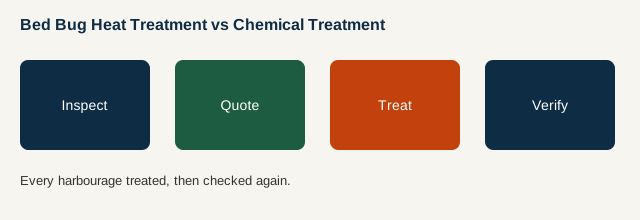
Heat treatment kills by temperature. The room is raised to a level lethal to bed bugs and held there until the heat has soaked into every harbourage, mattress core, frame joint, sofa fold. Its decisive advantage is the eggs: where insecticides largely fail against eggs, temperature does not distinguish life stages. A completed heat treatment is complete on the day, which is why rentals choose it when the booking calendar is the loudest voice in the room.
Chemical treatment kills by contact and residue. Products are applied to the harbourages and to the routes bugs travel, and they keep working after the visit. Its decisive advantage is that residual: a chemical programme guards the room between visits. Its structural cost is the egg problem answered by time instead of temperature: the programme must return as eggs hatch, over weeks, and it only ends when the cycle does.
Preparation differs, and households feel the difference. Heat asks for the removal of heat-sensitive items and the arrangement of the room for airflow; chemical asks for laundering, bagging, decluttering and vacating for the treatment windows. Neither is light. The preparation that suits a household's reality is a legitimate part of the choice, because the best method on paper fails in a room that could not be prepared for it.
Cost comparisons are where the quoting games live. Heat is one larger figure; chemical is a smaller figure repeated across a programme. Compare heat against the whole chemical course, initial visit plus its follow-ups, and the gap narrows or closes; compare it against the first chemical visit alone and you are comparing a finished job with a third of one. Any provider should lay the full course out in writing, and reluctance to do so is information.
Failure modes differ too, and they are worth knowing before choosing. Heat fails when a harbourage never reaches temperature, a cold pocket inside dense furniture, which is why sensor placement is the craft of the method. Chemical fails when a harbourage is never reached by product or preparation, or when the follow-ups are skipped and the eggs inherit the room. Both failures are failures of thoroughness, not of chemistry or physics, which is why the provider's method matters more than the method itself.
There are properties that decide the question on their own. A heavy, multi-room infestation leans heat, for completeness in one pass. A single early room in a home that cannot be heated for structural or contents reasons leans chemical. A building with adjoining units leans toward whichever programme includes the neighbours, because in a building the method matters less than the map.
The honest providers in this trade offer both, recommend from the inspection, and can explain the recommendation in terms of your rooms rather than their equipment roster. If a quote arrives before an inspection, or only ever names one method, treat it as a sales document. The decision between heat and chemical is a real one, and it deserves real evidence.
Rentals tilt the calculation in one more way worth stating plainly. A chemical programme's return visits need the property empty and prepared on schedule, which in a booked rental means either blocked nights or a programme that slips; a slipped programme is a failed one. Heat's single visit, verified the same day, fits the gaps between stays that actually exist. That is why so many island and corridor properties land on heat even when the household maths might have landed elsewhere: the calendar is a real cost, and pretending otherwise produces programmes that exist on paper and nowhere else.
Whichever method you choose, the finishing moves are the same: encase the beds, keep the record, and verify. The method kills the infestation; the system around it is what keeps the property from starting the story again with the next suitcase. And if a provider cannot explain, in your rooms and with your map in hand, why their recommended method fits your infestation better than the alternative, you have not yet found the provider this decision deserves.
The guidance collected by https://www.epa.gov/bedbugs runs through both posts: identify first, prepare thoroughly, treat completely. If you would like the facts for your own property, an inspection answers bed bug heat vs chemical treatment with a map and a written finding instead of opinions.
Frequently asked questions
Does this apply outside Bradenton?
The biology applies everywhere. The local pressure, tourism, turnover and year-round warmth, is Bradenton's, and it is why vigilance here is a system rather than an event.
Should I throw out my mattress?
Almost never as a first move. Most mattresses are treatable and then encased. The inspection names the rare exception honestly; panic disposal mostly spreads bugs through the building on the way to the dumpster.
What does bed bug heat vs chemical treatment have to do with my rental's reviews?
Everything, in a tourist market. A single bed bug review outweighs a season of praise, and the only defence that works is a documented record of inspections and fast, complete responses.
Bed bugs in your Bradenton home? Call now.
Available 24/7. You talk with the provider directly before any work is agreed.